How BaseKM used payouts webhooks to automate settlement reconciliation
Jaime Hing III
April 7, 2026
•
#
min read
Settlement reconciliation is where payments meet reality.
For many businesses, this process starts with reports: exporting data, reviewing totals, and ensuring everything lines up. The PayRex payout module provides a reliable view of every payout and its transactions, e.g., payments or refunds. You can view or export every payout and see all its transactions in a single CSV file.
But as your operations grow, the question shifts from accuracy to efficiency. How do you move from manually exporting the payouts for reconciling data to having your system do it for you?
From manual reconciliation to automation
Most teams begin with a report-driven workflow. You define a cutoff period, export your data, and reconcile based on that snapshot. This approach works well and remains a dependable way to review your transactions.
However, as volume increases, manual steps take longer. Teams find themselves repeating exports, cross-checking totals, and double-checking whether everything is included before closing a period. At some point, the need shifts from “Is this correct?” to “How do we do this faster and more consistently?”
Using webhooks as a trigger for automation
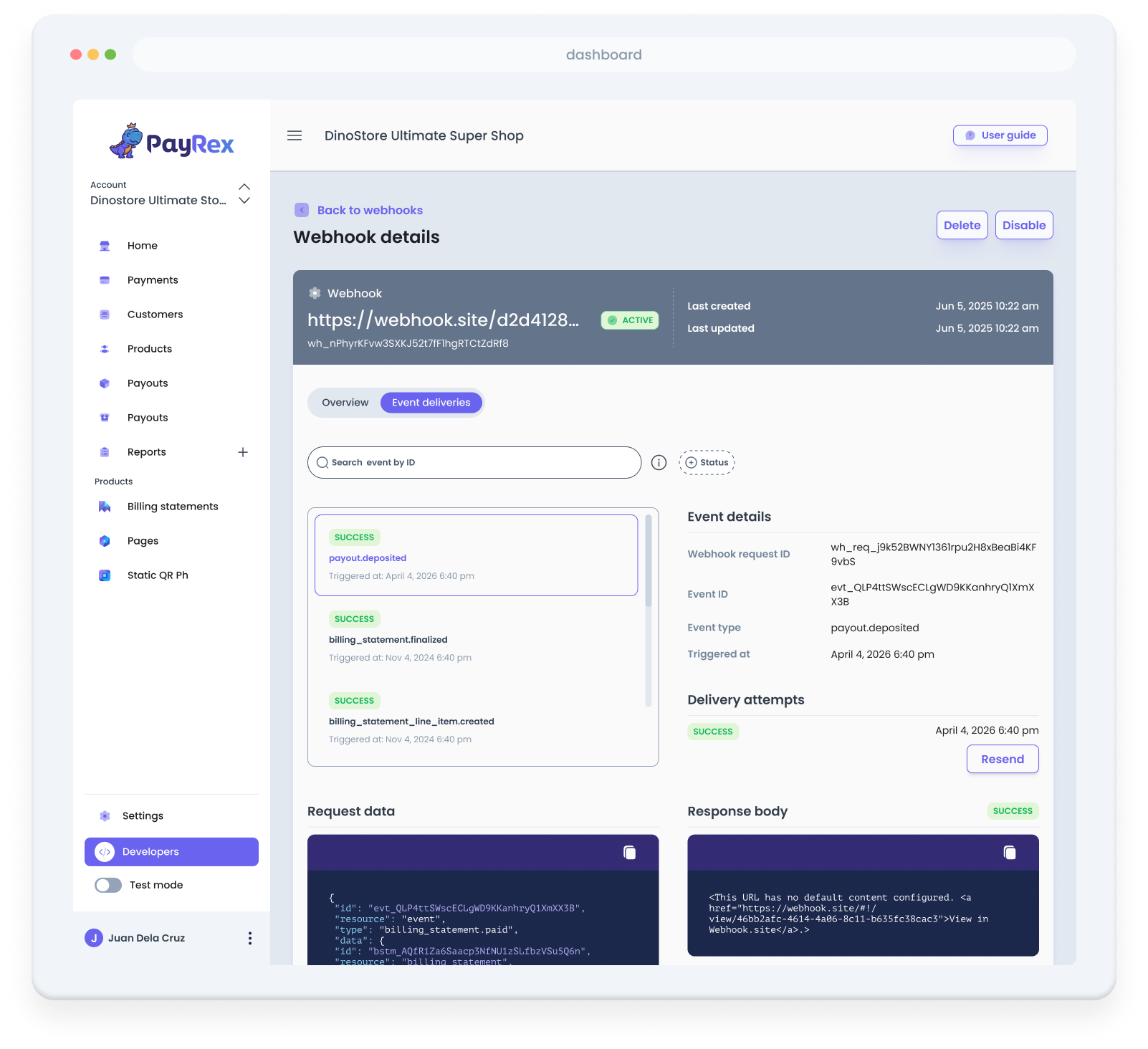
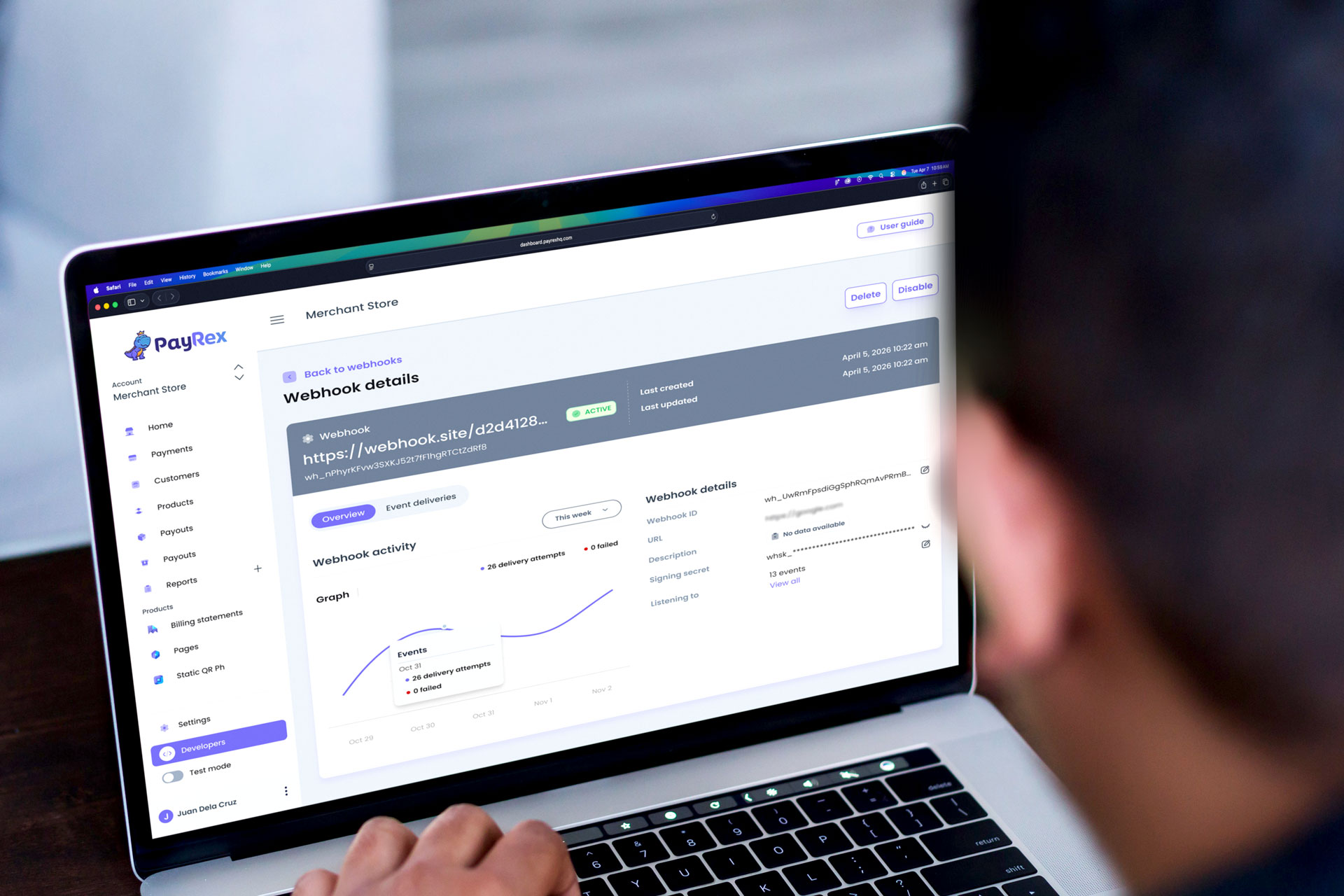
PayRex webhooks are useful for automated reconciliation. A webhook receives events that happened from your PayRex merchant, and one of them is the `payout.deposited` event. This event is sent when a payout has been successfully deposited to your bank account, and the amount is final. It acts as a real-time signal that a settlement is complete.
Instead of replacing reports, this event complements them. It allows your system to react to settlement, rather than waiting for someone to export the report and initiate the reconciliation manually.
How BaseKM approaches this
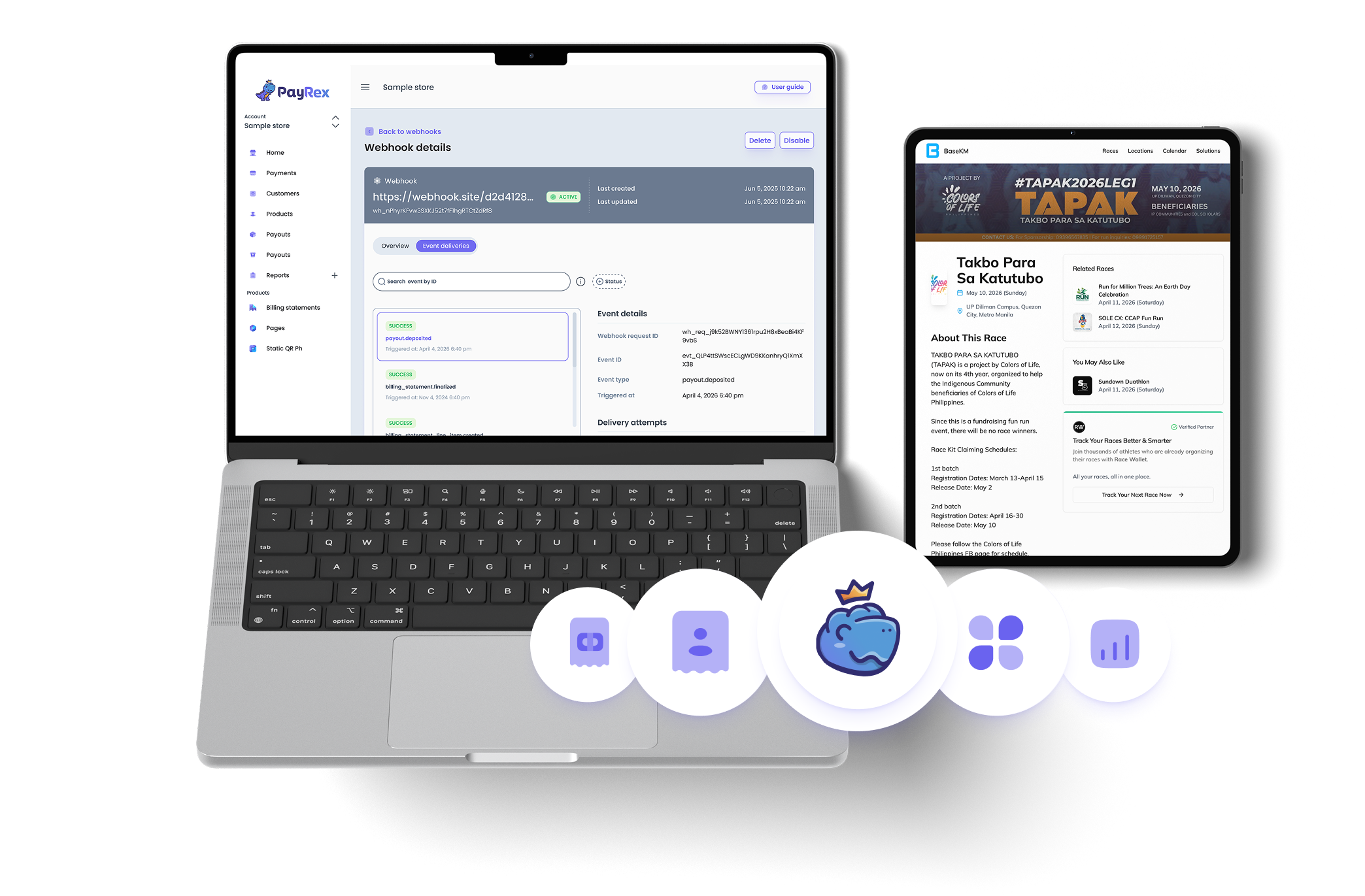
An events platform like BaseKM uses PayRex to manage payments and weekly payouts to organizers.
Here's how they described their approach:
“Since I'm doing a weekly payout to the organizers, this webhook event looks promising. This could allow me to automatically include or exclude participants in the given period as long as I receive the webhook event on time.”
In their integration, the webhook acts as the trigger, but the actual reconciliation is driven by data they pull via API. Upon receiving a `payout.deposited` event, they query the list payout transactions endpoint to retrieve all transactions associated from a payout and trigger their business rules. Using webhooks and the specified endpoint is the same as downloading the payout report from the PayRex dashboard, but this time it's automated.
From there, they apply their own logic:
Determining which participants are included in the settlement
Calculating allocations for events
Generating their internal payout records
Listening to `payout.deposited` event via webhook tells them when to act. The list payout transactions endpoint gives them what to act on.
Webhook + API: how the pieces fit together
The most effective pattern is to use both:
`payout.deposited` webhook event - acts as the trigger when a payout is deposited
List payout transactions endpoint: provides the full transaction dataset for a given payout.
This combination keeps your system both automated and precise. Instead of reconstructing payouts from raw transaction exports, you can directly fetch the exact set of transactions that PayRex has already grouped into that payout.
What PayRex provides, and what you control
PayRex provides both the data and the signals. Payout reports provide a complete, reliable view of your transactions and payouts. Webhooks notify you when the settlement is complete. The payout transactions endpoint gives you a programmatic way to retrieve exactly what's included in that settlement.
From there, your system remains in control. You define how transactions are interpreted, grouped, and allocated based on your business model.
Why businesses use this approach
Businesses that adopt this model are not replacing reports; they are reducing operational overhead. Instead of manually checking when a payout is ready and determining which transactions it belongs to, your system receives a signal and pulls the exact dataset it needs.
Automated reconciliation via webhooks removes guesswork and makes recurring workflows, such as daily or weekly payouts, much easier to manage at scale. Reports remain your source of truth for visibility and audit, while webhooks and APIs power the execution.
A simple implementation pattern
A typical flow looks like this: Start by listening for the `payout.deposited` webhook and verifying its signature.
When the event is received, extract the payout ID and call the list payout transactions endpoint to retrieve all the payout's associated transactions. Use that dataset from the endpoint to run your reconciliation logic, e.g., matching records, applying your business rules, and generating outputs such as reports or downstream payouts. Another common use case is to update your records in your ERP. You can create middleware that normalizes PayRex data for your ERP.
As with any webhook integration, ensure your system is idempotent to handle retries safely.
Bringing it together
Reports, webhooks, and APIs each serve a role. Reports help you review and validate. Webhooks tell you when to act, and the APIs give you the exact data to act on.
By combining `payout.deposited` with the payout transactions endpoint, you can automate reconciliation while keeping full control over your logic.
Final Note
Different businesses vary in when they trigger their financial reconciliation. Some reconcile when a payment is successful; you can use another webhook event for this. Other businesses reconcile when their payouts are deposited. PayRex supports both workflows.
If you want us to review how we can tailor-fit this solution to your needs, reach out to support@payrex.com or use our chat functionality to learn more.
In payment processing, APIs handle the requests you initiate, but webhooks handle the reality of what happens next. Whether a subscription renews, a customer’s